Adrian Bailey watched from the stands as England won the World Cup and 60 years on has written a book of his recollections. He also discusses the Cheltenham Town FC of his childhood and how the town and life has changed since the 60s.
Watch the full chat with Adrian Bailey below.
The idea of the book
Adrian Bailey has enjoyed a fascinating and diverse professional life – from librarian to MP for West Bromwich West. But football has been a core devotion of his 80 years.
The love of the beautiful game was sparked by watching Cheltenham Town FC as a boy in the late 1950s and he continues to follow The Robins home and away to this day.
He has a searing passion for England too. A passion cemented watching from the Wembley stands as Sir Alf Ramsey’s team beat West Germany 4-2 to become world champions on July 30th 1966.
With nearly 60 years having passed since that day, Bailey realised that his first-hand recollections might be important. Sir Geoff Hurst, at the time of writing, remains the only member of the starting 11 still with us.
“I think cathartic is the word. I started to write it after England went out of the World Cup in 2022,” Bailey told Sport and Life.
“I realised with the deaths of so many, not just the England players, but other stars like Pelé, that if footballers were dying the people who watched them were dying off as well.
“And that as one of the survivors it was incumbent upon me to try and get down on paper just what the experience was like for my descendants.
“I enjoyed doing the research and reliving the memories of that age and I hope that all comes through in the book.”
A football passion born at Whaddon Road
It does come through in the book 1966 England’s Glory Match. Bailey does a great job of helping us live the age and the Wembley scene on the famous day.
That ‘glory match’ came 8 years after Bailey’s first taste of watching football – a win for The Robins at Whaddon Road.
“My dad took me in 1958 when Cheltenham played Kidderminster Harriers and they won four-nil. I remember Frank Carney scoring a couple of the goals. I believe Danny Fowler and possibly Alan Gibbs were the other scorers.
“From them on I watched every game I could.”
A team and a town on the up
The idea of Cheltenham Town being in the football league and employing their players full-time would have seemed like an impossible prospect on that day in 1958.
But nearly 70 years on not only has the club enjoyed 26 of the past 27 years as a professional football league club, Bailey says the town itself has grown into a completely different place.
“GCHQ has been a huge driver in the change in population here and you’ve got what I think is a far more bohemian, outward looking and well educated population.
“The town is very vibrant and colourful, much more so than it was in the 60s.”
Hurst – from unused sub to eternal hero
Younger football fans raised on the image of Sir Geoff Hurst hammering the ball into the net to seal England’s World Cup victory and his hat-trick might be mistaken for assuming the striker had been a national star for sometime.
But Bailey’s book reiterates the sliding-doors moment that lead to Hurst even getting a kick at the World Cup.
In those days tactical substitutions were not allowed. Only a gashed leg for Jimmy Greaves created the opportunity for Hurst to play in the quarter-final and semi-final. He then got the nod for the final ahead of Greaves who was at the time revered as a world class striker.
Bailey recollects a national debate over who should start up front out of the three centre forwards: Greaves, Hurst and Roger Hunt.
“It was a huge issue in the run up to the game. It’s divided London fans for years because you had Jimmy Greaves playing with Spurs, Hurst for West Ham.
“A lot of London fans felt that Roger Hunt should have been dropped to accommodate them, but I don’t think it was ever in Sir Alf Ramsey’s mind that Greaves AND Hurst would start.”
Joy and fleeting triumph following the 4-2 win
On that heady summer evening, 20-year-old Bailey and the nation not only rejoiced the win, but a sense that order had been restored and the inventors of the game had retaken their rightful place at the summit of football.
But fast forward 60 years and England haven’t won anything since. That hasn’t changed (pending World Cup 2026!) but football has changed massively. And so has Cheltenham.
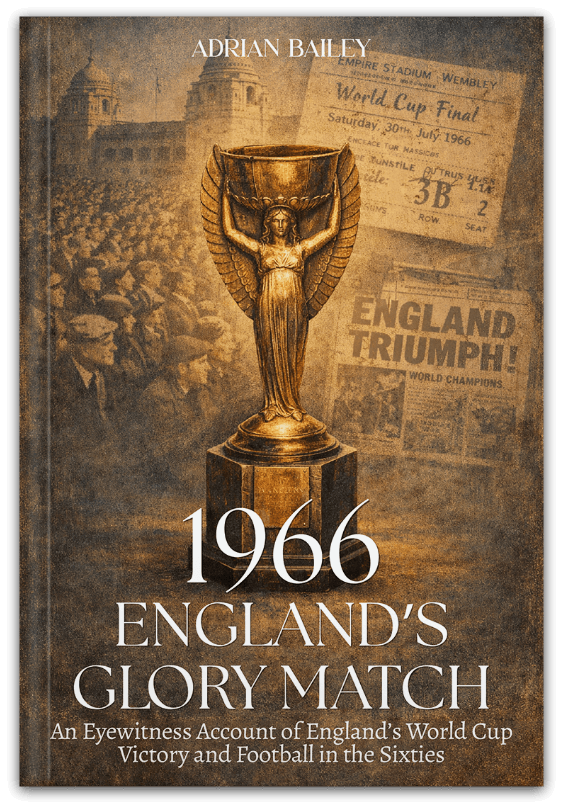
To find out more about Adrian Bailey and to order a book go to: www.adrianbailey.uk